SUPPORTING AI LAYER / HUMAN-IN-THE-LOOP MODEL DEVELOPMENT

Train. Evaluate. Deploy.
Make your AI fit your needs.

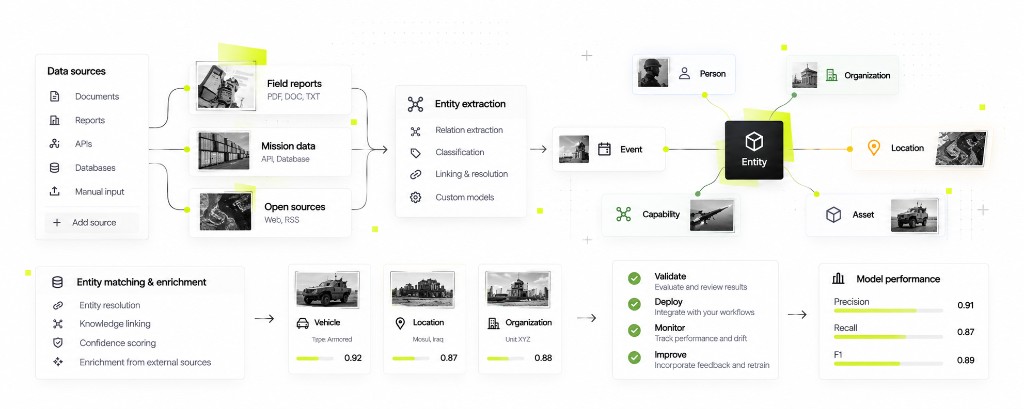
Bring raw data, model improvement, and ontology building into one easy to use data-driven workflow. Provide feedback on operational failures to improve the results.

THE PROBLEM IT SOLVESSiloed labeling, model training, and ontology design tools make it difficult to deploy ontologies and models that fit your need. Candor keeps your ontology mission-specific and your ML models improving over time.
See Minsky Candor in action
ExploreOntologyAnnotateEvaluateImproveDeploy
01

Exploration

Discover a schema before committing to one. Start from pre-built datasets — news, domain corpora, and reference collections — or stream your own data. Use agent-driven clustering, sampling, pattern discovery, frame and role mining, and data hygiene checks.

02

Ontology

Build and refine mission-specific schemas, taxonomies, and frame definitions. Use agent-assisted ontology design, version-controlled schema changes, and collaborative review to keep your knowledge model aligned with mission requirements.

03

Annotation

Focus labeling where it moves the model most — uncertainty, diversity, or random active-learning sampling picks the batch. Label classification, NER, entity linking, relation extraction, and semantic role labeling tasks with inline model suggestions, knowledge-base linking, and keyboard-driven workflows.

04

Evaluation

Compare model outputs, correct them in context, and track quality over time. Settle annotator disagreements in three ways: random draw, experience-weighted, or latest-wins. Standard agreement metrics measure inter-annotator consistency. Learning curves show you exactly when to stop labeling.

05

Continuous improvement

Detect systematic production errors, draft corrections, route them for expert validation, and queue retraining so models keep learning from the mission.

06

Model serving & pipelines

Promote models from experimental to production with one-click approval. Deploy versioned endpoints and multi-model pipelines — each model checks whether incoming data is within its training range and withholds predictions when it isn't, instead of guessing. Track model performance in production against the quality benchmarks set during training, so you know the moment something drifts.

MINSKY CANDOR / IN PRACTICE

Works with people, services, and agents

Your analysts, your automated pipelines, and AI agents all work through one system — via the web interface, an API, or as an MCP server. All Minsky solutions are accessible through leading AI assistants. The exploration workflow helps discover new entities and schemas; the improvement workflow analyzes production errors and routes fixes for expert review.

Any source. Any task. Any system.

Start from pre-built datasets or stream your own data from relational, columnar, and graph databases, files, and any S3-compatible blob storage. Candor applies your pipelines to any incoming stream and pushes results to any downstream system via webhooks, APIs, or message queues — no custom integration required. Corrections and flags flow back in the same way. Works across classification, clustering, entities, relations, and semantic roles.

Governed, auditable, searchable

Every prediction is searchable — filter by label, confidence, model version, and provenance, and export any slice. Cost records track every training run and inference job. Budgets, quotas, and an append-only audit log give operators full visibility. Role-based access controls who can see and change each dataset and model. Schema versioning records which ontology version every annotation was made against, so experiments stay reproducible and audits stay clean.

Pipeline analytics

Analyze results produced by any pipeline — explore them directly in Candor's built-in Explorer, or ask questions in plain language through Minsky Assistant. Drill into outputs across pipeline stages, surface errors and edge cases, and feed findings directly back into the annotation and improvement loop.

A typical pipeline

Chain models to match your mission. Raw text flows through normalization, named entity recognition (NER), entity linking to knowledge bases (NEL), document classification, and topic modeling — each stage feeding the next without custom glue code. Results are available for exploration in Candor's Explorer or stream to any third-party system.

Multi-backend training

Train across scikit-learn, spaCy, SetFit, HuggingFace, and LLM backends and compare them head to head. Every model version pins its training-data snapshot, hyperparameters, metrics, and artifact location. Learning curves and experiment tracking show when you've reached the ceiling — and which backend got there fastest.

SUPPORTING AI LAYER / BUILD & IMPROVE

Expert feedback becomes institutional learning.

Candor is a supporting AI layer that helps build, evaluate, and continuously improve the models behind our products. Minsky Platform supplies the shared knowledge foundation; IPE and STIO apply it to mission workflows. Candor is part of Minsky One.

What is your mission
and what are your questions?

Contact us to describe your use case. We’ll show you how Minsky can solve it today.

About Minsky Candor

Prefer email? Talk to our team